
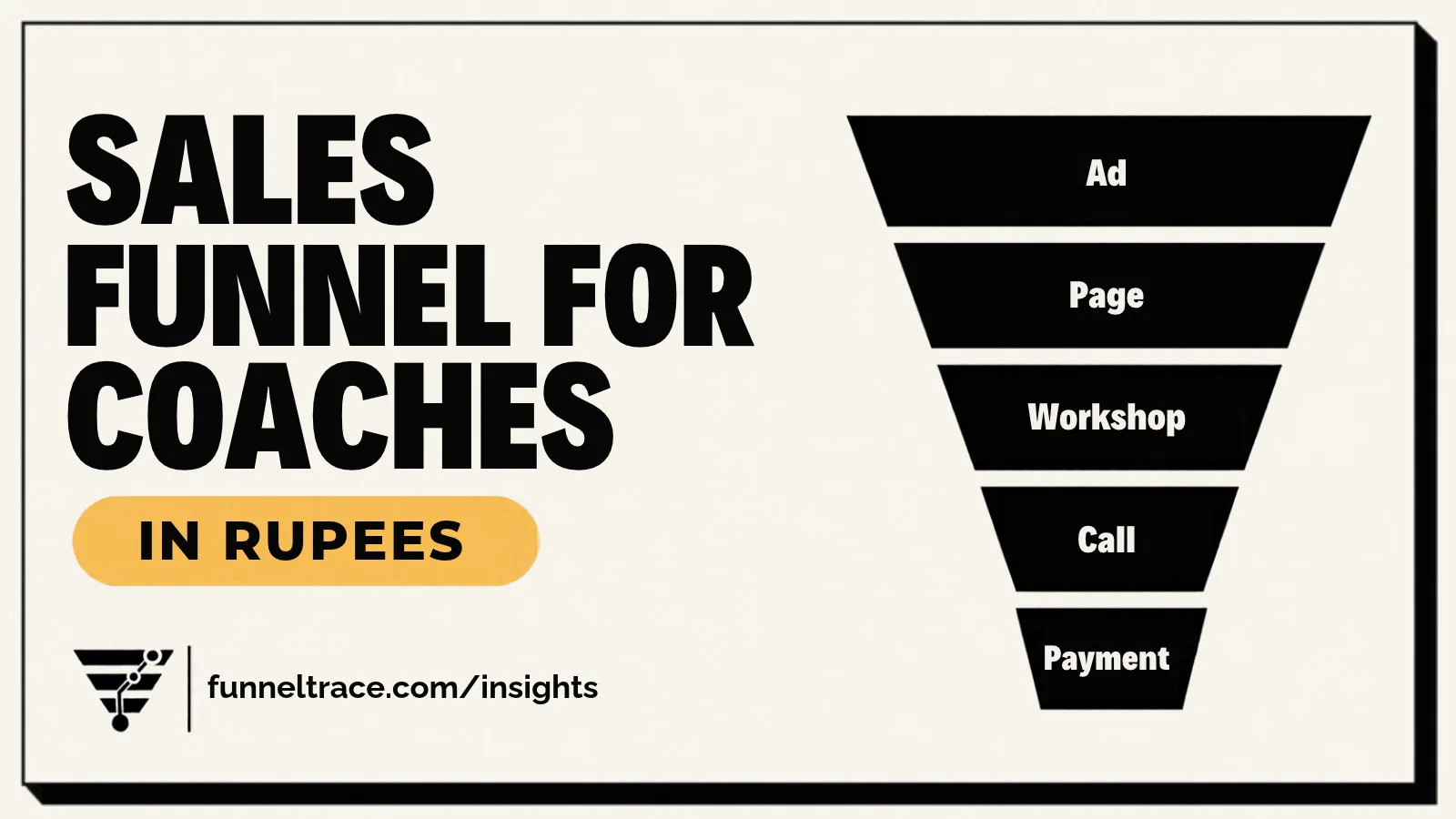
Every month I see coaches celebrate a cheap cost per lead in Ads Manager. Then I ask which ad brought the people who actually paid, and the room goes quiet. A sales funnel for coaches exists to answer that question.
It's one fixed path from an ad to a payment, with a number you can read at every step. Build the path first. Then judge it by cost per paying client, never by cost per lead.
This guide is for Indian coaches and consultants who already sell a programme and already run Meta ads. I'll walk through the five steps, which funnel suits which price, and one full month worked out in rupees.
In 30 seconds
A coaching funnel has five steps: ad, capture page, trust event, sales conversation, payment. One thread runs through all of them: the tag that says which ad the person came from.
In my illustrative month, ₹1,00,000 of ads gives 400 workshop registrations at ₹250 each and 6 clients at ₹16,667 each. The second number decides whether you scale.
The ad with the cheaper registration can cost five times more per paying client. You only see that when the payment is recorded against the lead.
Razorpay's standard fee is 2% plus 18% GST, so a ₹45,000 payment costs ₹1,062 to collect (checked 26 Nov 2026).
If you have not yet sold your programme by conversation to a handful of people, fix the offer before you build anything.
What is a sales funnel, in plain words?
It is a sequence you decide in advance. Someone sees an ad, lands on one page, takes one small step, gets to know you, talks to you or your team, and pays.
"Funnel" only describes the shape. Many people enter, fewer reach each next step, and a few pay. Your job is to know how many drop at each step and what each survivor has cost you so far.
Your Instagram profile, website and WhatsApp number are places people wander around. A funnel gives a cold visitor exactly one thing to do next.
What are the five steps?
Every coaching funnel I've seen described, whatever it's sold as, is some arrangement of these five.
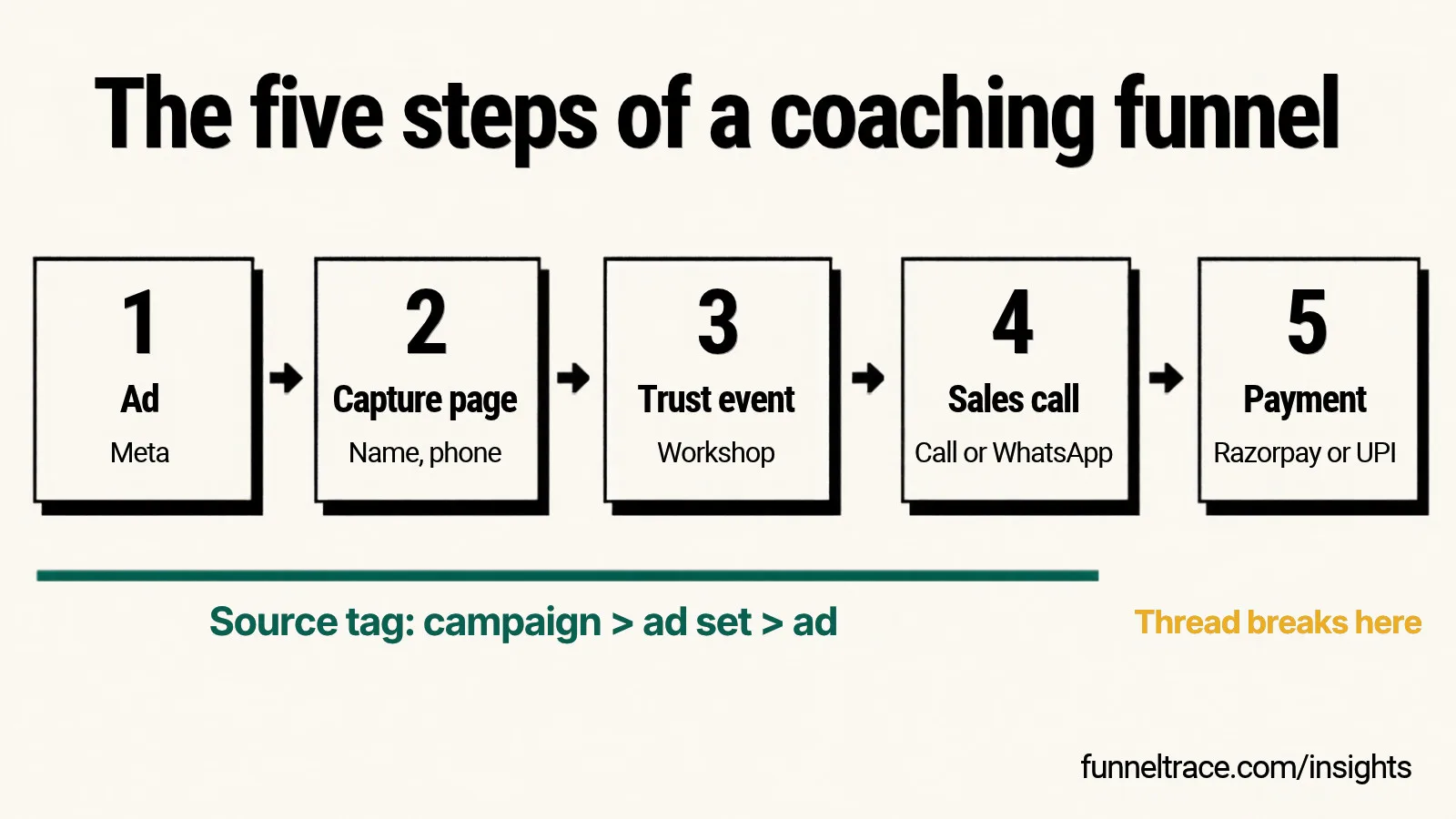
The ad. A Meta ad that makes one promise to one kind of person. Its only job is to send the right people to the next step.
The capture page. An opt-in page, workshop registration page or application form. A stranger becomes a name and a phone number here. It's also the only place you can reliably record which ad they came from.
The trust event. Something that lets people experience your thinking before a sales conversation: a live workshop, a recorded masterclass, or a useful lead magnet followed by a few days of messages.
The sales conversation. Above roughly ₹15,000 to ₹20,000, most Indian coaches close on a call or WhatsApp, not on a page. That threshold is my rule of thumb, not a benchmark. Speed of WhatsApp lead follow-up decides a lot here.
The payment. A Razorpay link, a checkout page, or a UPI transfer with a screenshot on WhatsApp. Most guides stop before this step. They shouldn't, because this is where the funnel closes its loop or loses it.
Where does the thread usually break?
Between steps 4 and 5.
The lead registered through a page, so the ad is known. Then the sale happens on a call, the client pays ₹45,000 by UPI to your number, and the payment lives in a bank statement and a WhatsApp screenshot. Nothing connects that money to the registration.
So at month end you know cost per lead for every ad, and total revenue, and nothing in between. You scale the ad with the cheapest leads. Often that's the wrong ad.
Cost per lead or cost per paying client?
This is the single idea I'd ask you to keep.
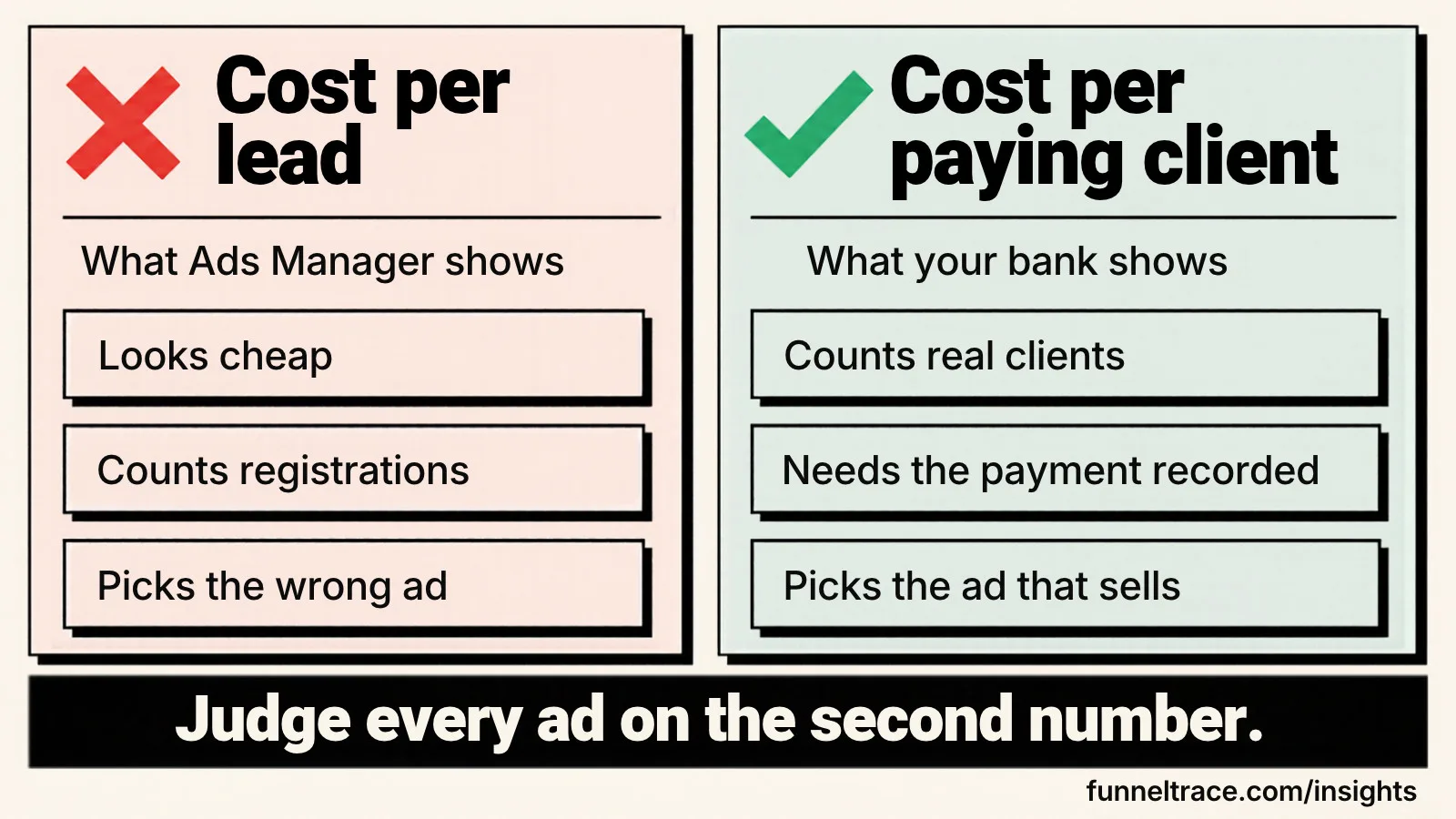
Cost per lead is easy to see and easy to love. It's on your Ads Manager screen every morning. Cost per paying client is harder, because it needs the payment recorded against the person. But it's the only number that tells you which ad to put more money into.
Which funnel fits your price?
There are dozens of named funnels. For a coach selling a programme in India, three do most of the work.
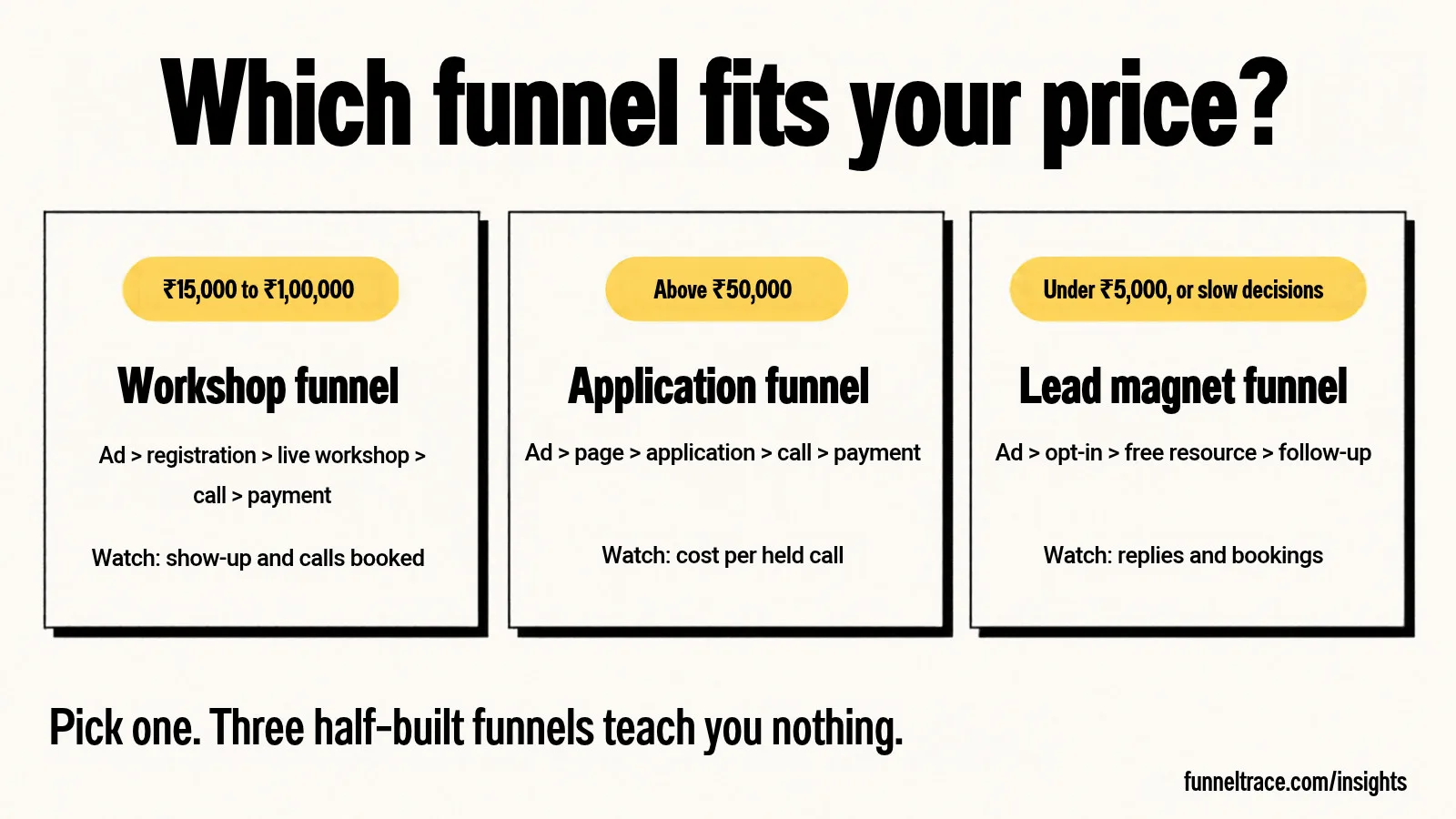
Workshop funnel
Path: ad, registration page, live workshop (free or ₹99 to ₹499), call or WhatsApp, payment.
Best for: programmes from about ₹15,000 to ₹1,00,000, sold to people who don't know you yet.
Skip if: you can't run a live session every week or two, or your audience is too senior for a group workshop.
Watch: show-up rate and calls booked per attendee.
A small entry fee is a tripwire offer: it filters for people willing to pay something.
Application funnel
Path: ad, a page that makes the case for the programme, application form, call, payment.
Best for: programmes above roughly ₹50,000, where you'd rather speak to 30 serious people than 300 curious ones.
Skip if: you have no proof to show (results, a clear method, a known name). Cold traffic won't apply on a promise alone.
Watch: cost per held call and close rate.
Lead magnet funnel
Path: ad, opt-in page, free resource, several days of follow-up, call or low-priced offer.
Best for: building a list cheaply when buying takes weeks, or selling something under about ₹5,000 directly.
Skip if: you need clients this month. It's the slowest of the three to pay back.
Watch: how many opt-ins reply or book, not how many download.
Pick one. Three half-built funnels is the most common way I see ₹1 lakh teach nothing.
What does one month look like in rupees?
Here's an illustrative month for a workshop funnel. Every rate is an assumption I chose to keep the arithmetic easy. None of it is a benchmark, and your numbers will differ.
Say you spend ₹1,00,000 on Meta ads, sell a ₹99 live workshop, and offer a ₹45,000 programme on calls afterwards.
Registrations: at ₹250 each, ₹1,00,000 ÷ ₹250 = 400.
Workshop revenue: 400 × ₹99 = ₹39,600.
Attendees: 50% show up, so 200.
Calls booked: 16% of attendees, so 32.
Calls held: 75% turn up, so 24.
Clients: 25% of held calls close, so 6.
Programme revenue: 6 × ₹45,000 = ₹2,70,000.
Total revenue: ₹39,600 + ₹2,70,000 = ₹3,09,600.
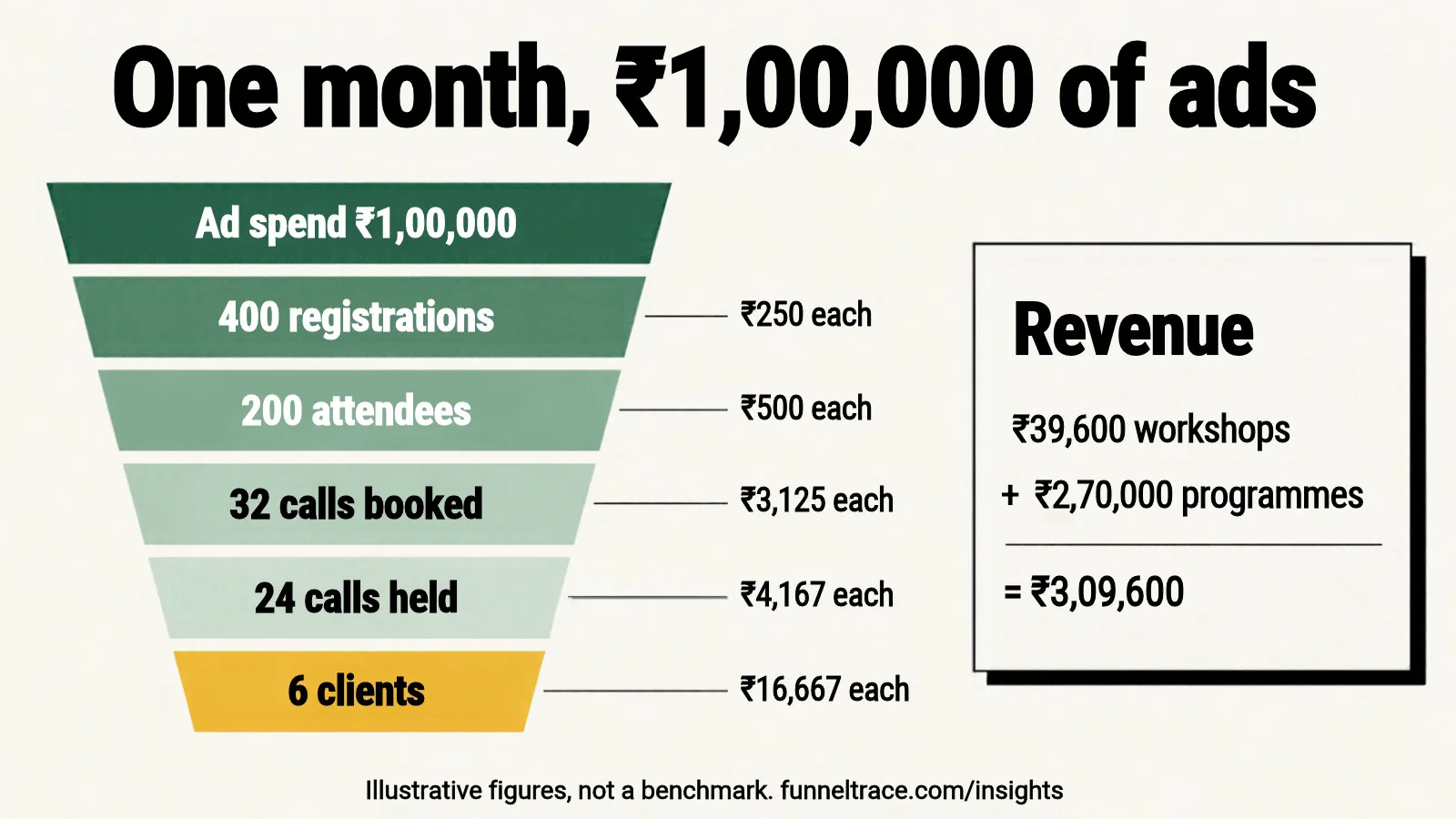
Divide the same ₹1,00,000 by each step and the story changes: ₹250 per registration, ₹500 per attendee, ₹3,125 per booked call, ₹4,167 per held call, and ₹16,667 per paying client.
Return on ad spend is ₹3,09,600 ÷ ₹1,00,000 = 3.1. On the workshop alone it's ₹39,600 ÷ ₹1,00,000 = 0.4, which is why a ₹99 workshop judged on its own always looks like a loss. Net of workshop fees, the ad cost per client is (₹1,00,000 − ₹39,600) ÷ 6 = ₹10,067.
What's left after the payment gateway?
If every rupee came through Razorpay at the standard rate, the fee would be 2.36% of ₹3,09,600, which is ₹7,307. That leaves ₹3,09,600 − ₹1,00,000 − ₹7,307 = ₹2,02,293, before your time, team, tools, refunds and tax.
I've left GST on your own fees out to keep it readable. If you're registered, the GST you collect isn't your revenue. This is general information; confirm your position with a CA.
One small change, a very different month
Keep everything the same, but let call show-up fall from 75% to 50% because nobody sent reminders.
Calls held: 32 × 0.50 = 16
Clients: 16 × 0.25 = 4
Total revenue: ₹39,600 + (4 × ₹45,000) = ₹2,19,600
Cost per paying client: ₹1,00,000 ÷ 4 = ₹25,000
The ads didn't change. Cost per registration is still ₹250 and looks healthy in Ads Manager. Cost per client rose by half, and only a funnel measured to the payment shows you why.
The same budget as an application funnel
Illustrative again. ₹1,00,000 at ₹400 a lead gives 250 applicants. If 20% book (50 calls), 60% turn up (30 held) and one in six closes, you get 5 clients: ₹2,25,000 of revenue and ₹20,000 per client, from 30 calls and no workshop to run.
Neither set of assumptions proves one funnel beats the other. Compare funnels on cost per client and hours spent, using your own rates.
Are these numbers normal?
Honestly, nobody knows. Anyone who quotes you a precise Indian benchmark is guessing.
Agency estimates are all that exist. Nico Digital's roundup of four published guides puts coaching leads at ₹60 to ₹200 and general education leads at ₹150 to ₹600, and notes that none of them publishes a sample size (checked 18 Nov 2026).
For free webinar registrations, AXZ Lead estimates ₹30 to ₹80 from what it calls proprietary data (checked 18 Nov 2026). I found no published figure for paid ₹99 registrations, so the ₹250 above is purely an assumption.
On show-up, Livestorm reports a 46% average attendance rate across more than 7 million registrations on its platform (checked 18 Nov 2026). Those are mostly business webinars, not Indian workshops promoted on Instagram, so treat it as a loose reference.
Use ranges like these to sanity-check a plan. Then replace them with your own last three months as fast as you can.
Which ad actually produced the clients?
Back to the illustrative month. The ₹1,00,000 was split evenly across two ads.
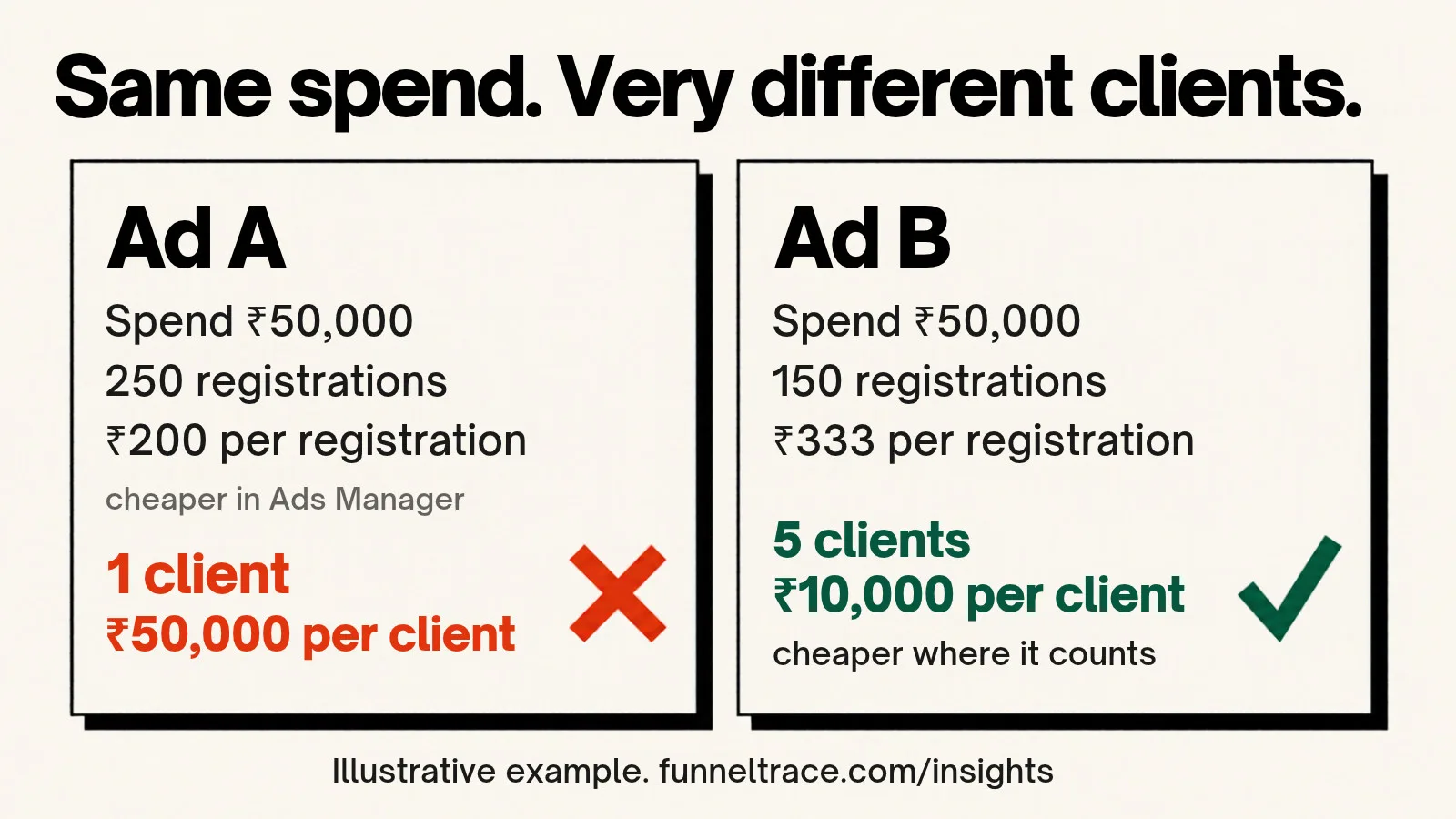
Ad A, a "free checklist" hook: ₹50,000 spent, 250 registrations at ₹200 each, 1 client. Revenue (250 × ₹99) + ₹45,000 = ₹69,750. Cost per client ₹50,000. ROAS 1.4.
Ad B, a "practice owners stuck at ₹2 lakh a month" hook: ₹50,000 spent, 150 registrations at ₹333 each, 5 clients. Revenue (150 × ₹99) + ₹2,25,000 = ₹2,39,850. Cost per client ₹10,000. ROAS 4.8.
The two add up to the month: 400 registrations, 6 clients, ₹3,09,600.
In Ads Manager, Ad A wins: its registrations are 40% cheaper, so that's where most coaches move the budget. Measured to the payment, Ad B brings clients at a fifth of the cost.
One caution. Six clients is a small number, and one lucky sale changes the picture. Don't kill an ad on one month of client counts. Look at two or three workshop cycles, or use booked calls per ad as an earlier signal.
How do you keep the thread from ad to payment?
Four things, and none of them needs a developer.
Tag every ad. Put UTM parameters on each ad's link so the campaign, ad set and ad names travel with the click.
Capture the tag on the form. Your registration page must save those values with the name and phone number.
Keep one row per person. In a CRM or a spreadsheet, with the source, each step they reached and the date.
Record the payment on that row. Every payment, including the UPI transfer confirmed by screenshot.
Step 4 is the discipline. A Google Sheet works if someone updates it the same day a payment arrives. It breaks once you pass a few hundred leads a month or have more than one person closing.
This is the part we built FunnelTrace for. It captures the UTM and click id on every lead, records Razorpay payments, UPI payments you enter by hand and sales from an outside checkout against the same person, and shows Meta spend against revenue per ad. It's paid, with no free plan, and access is by waitlist.
You can also send those purchases back to Meta so it learns from buyers instead of registrants. Meta recommends its Conversions API for events that happen off the page.
What does it cost to run?
Ads are the big line. The rest is smaller than most people fear, with one exception.
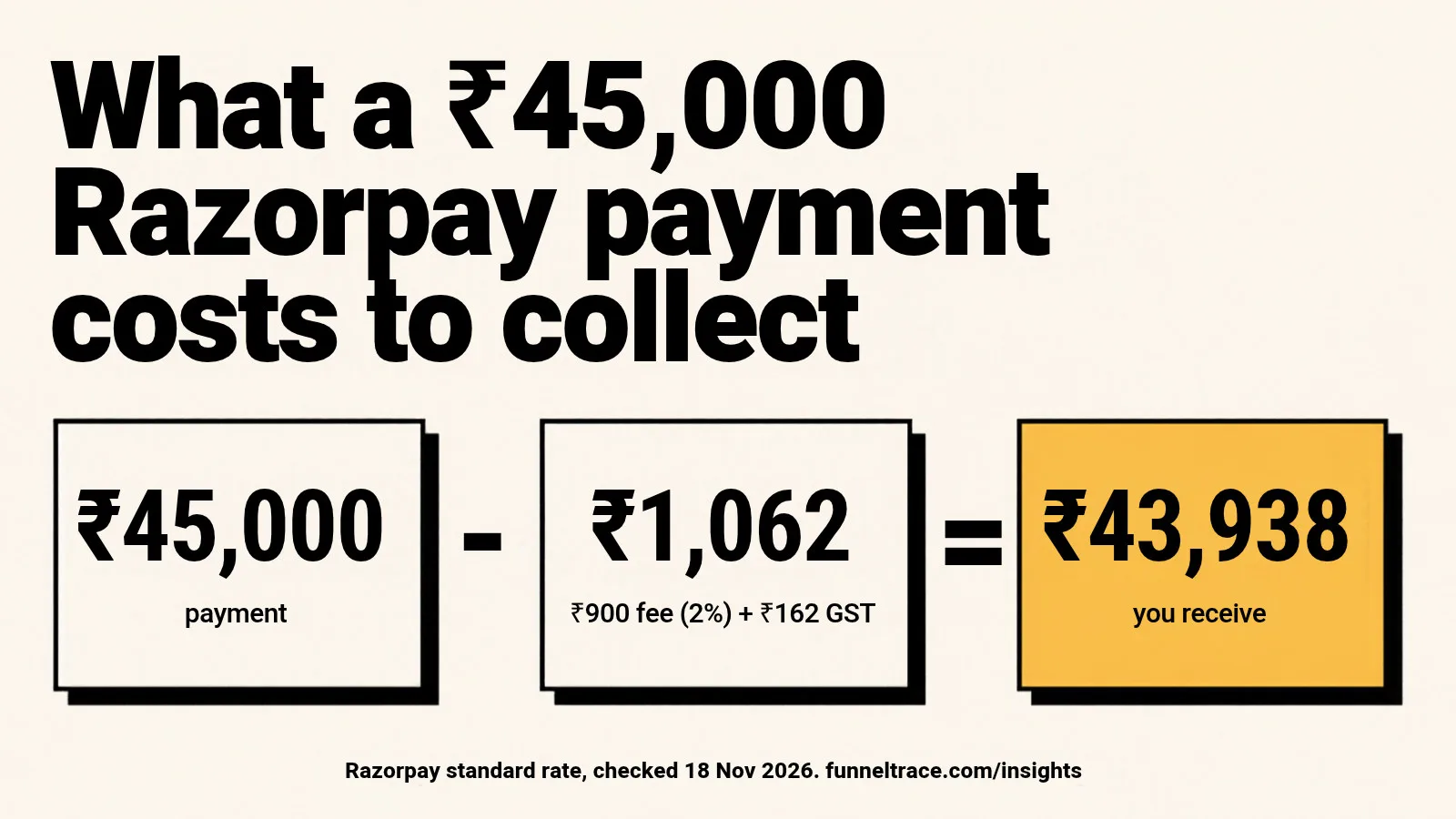
Payment collection. Razorpay's pricing page lists a 2% platform fee plus 18% GST on that fee, with no setup or annual charge (checked 26 Nov 2026). On a ₹45,000 payment that's ₹900 plus ₹162 of GST, so ₹1,062, and you receive ₹43,938.
UPI through the gateway isn't free to you. Razorpay's own explainer says the 0% MDR on UPI is separate from its platform fee, which still applies (checked 26 Nov 2026; the post carries no date, so confirm on your own rate card).
A direct UPI transfer to your bank skips the gateway fee. The price is that nobody reconciles it for you, which is exactly how payments get detached from leads.
Software. A page builder, a CRM or sheet, a webinar tool and a WhatsApp tool. Prices move often and some platforms take a cut of sales, so check current pricing pages before you commit.
Time. The exception. In the example month, 24 held calls at 45 minutes each is 18 hours of selling, plus the workshops, plus follow-up. If you're the only closer, your calendar caps the funnel before your budget does.
Where do coaching funnels usually break?
Check from the bottom up. Problems near the money are cheaper to fix and pay back faster than a new ad.
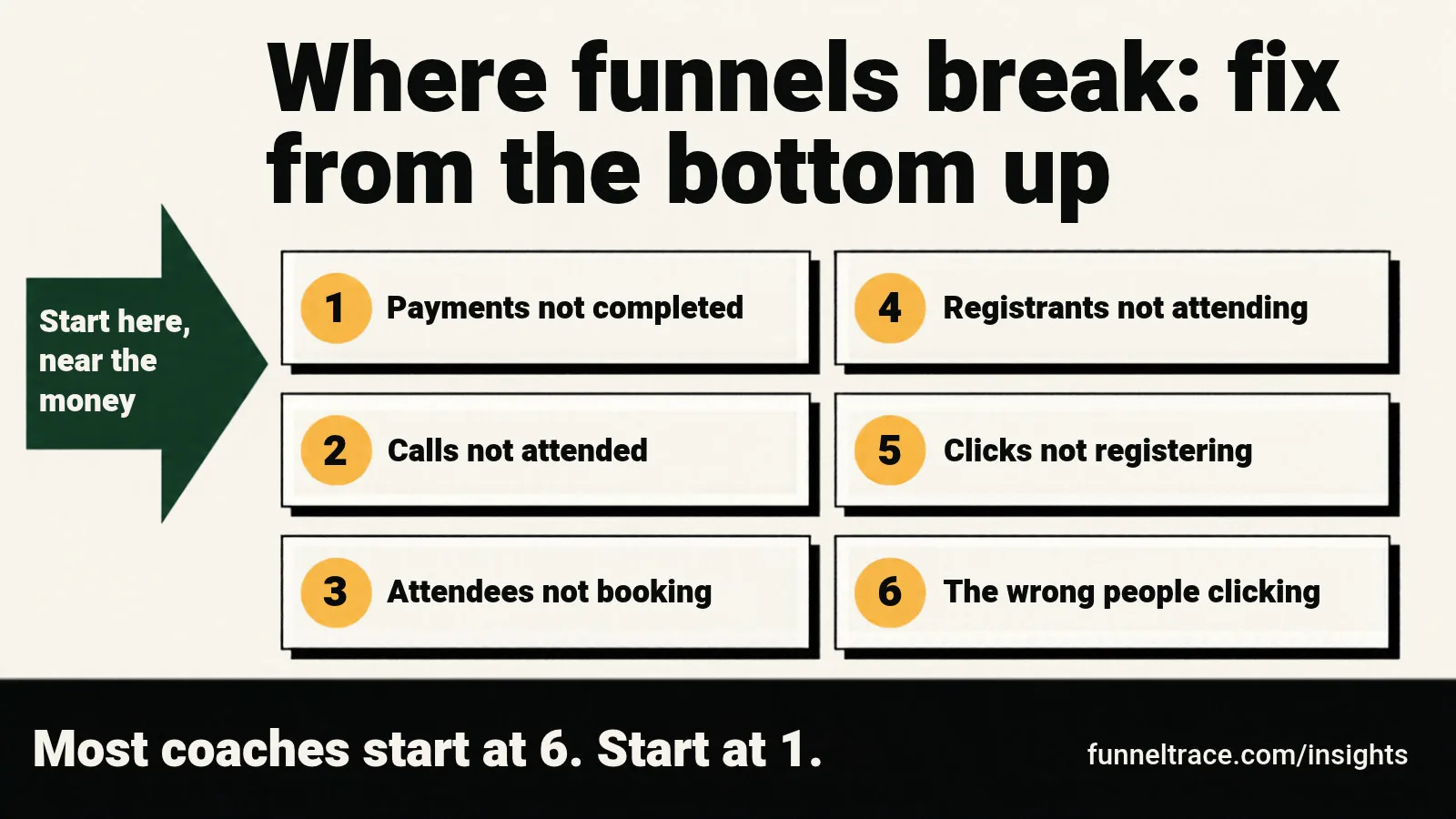
Payments not completed. People who said yes on the call and never paid. Often a failed UPI attempt nobody followed up.
Calls not attended. No reminder on the day, or the call was booked five days out.
Attendees not booking. The workshop taught well and never made a clear offer, or the booking link arrived the next morning.
Registrants not attending. Weak reminders, or a week's gap between registration and the session.
Clicks not registering. A slow page on mobile data, or a page that promises something different from the ad.
The wrong people clicking. Only now look at targeting and creative.
Most coaches work this list in reverse. They rewrite ads for a month while a third of booked calls quietly don't happen.
What should you build first?
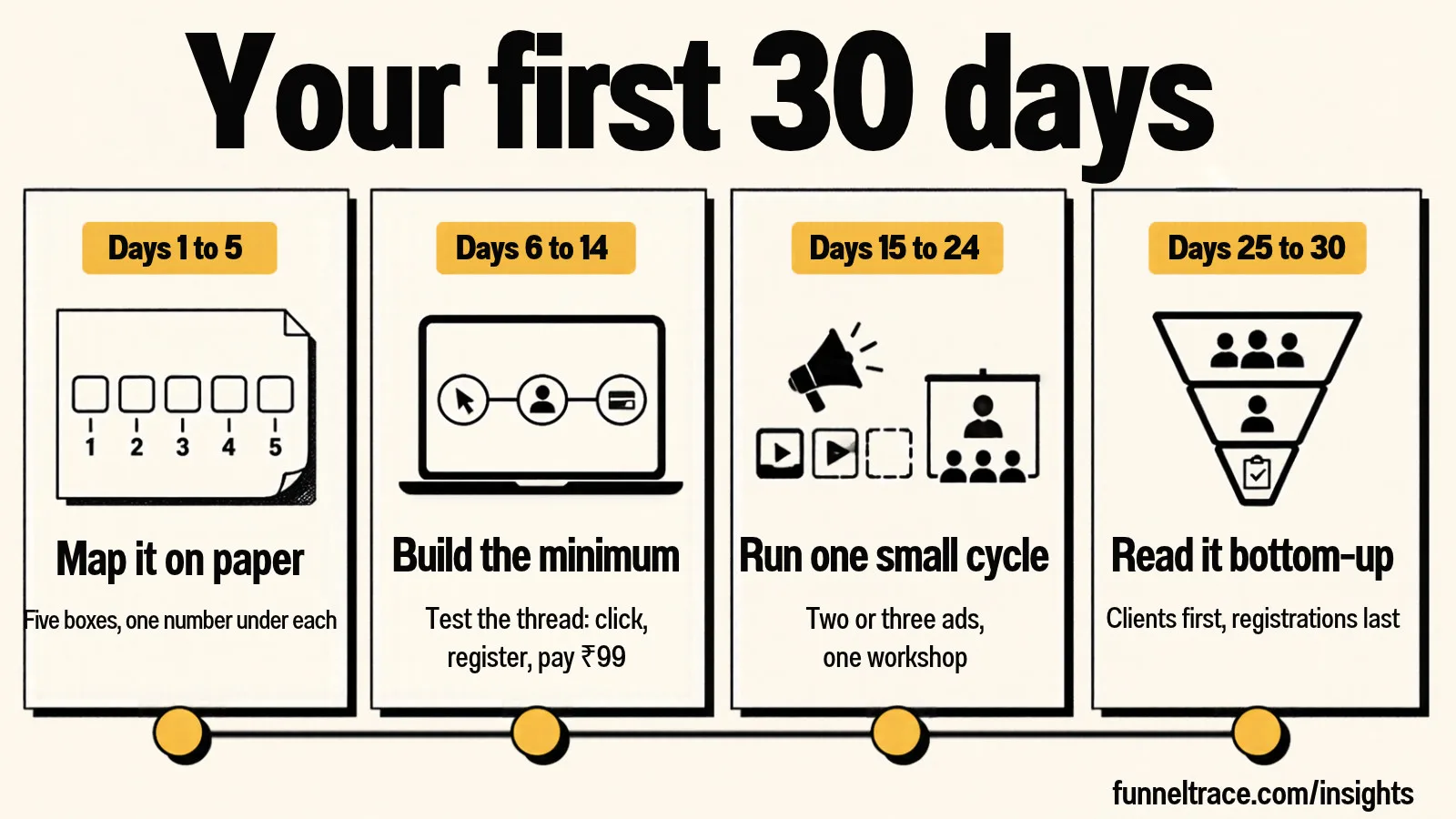
Days 1 to 5: map it on paper. One page, five boxes, one number under each, and the name of whoever owns that step. Fix the offer and price before any page exists.
Days 6 to 14: build the minimum. One registration page, one thank-you page, one payment method, one sheet or CRM. Then test the thread yourself: click your own ad link, register, pay ₹99, and check the source shows against your name. If it doesn't, stop. Don't spend on ads until it does.
Days 15 to 24: run one small cycle. Two or three ads, a budget you can afford to learn from, one workshop. Write every follow-up message by hand this round. You'll learn what people ask before you automate the answers.
Days 25 to 30: read the numbers bottom-up. Clients, held calls, booked calls, attendees, registrations, in that order, per ad. Change one step for the next cycle.
Stay live longer than feels comfortable. Recording the workshop makes sense once several live rounds have converted at a steady rate.
When should you not build a funnel yet?
A funnel multiplies what already works. It doesn't create it. Hold off if any of these is true:
You haven't sold this programme, at this price, to at least a handful of people through conversation. Ads will only show you faster that the offer is unclear.
You can't take sales calls, and nobody else can, for the next two months.
Your ad budget covers one month only. With client numbers this small, one cycle tells you very little.
You'd have to borrow to fund the ads.
In those cases, sell by referral, direct message and your existing audience first. Keep a sheet of who paid and where they came from. That sheet becomes the brief for your first funnel.
What I'm taking away
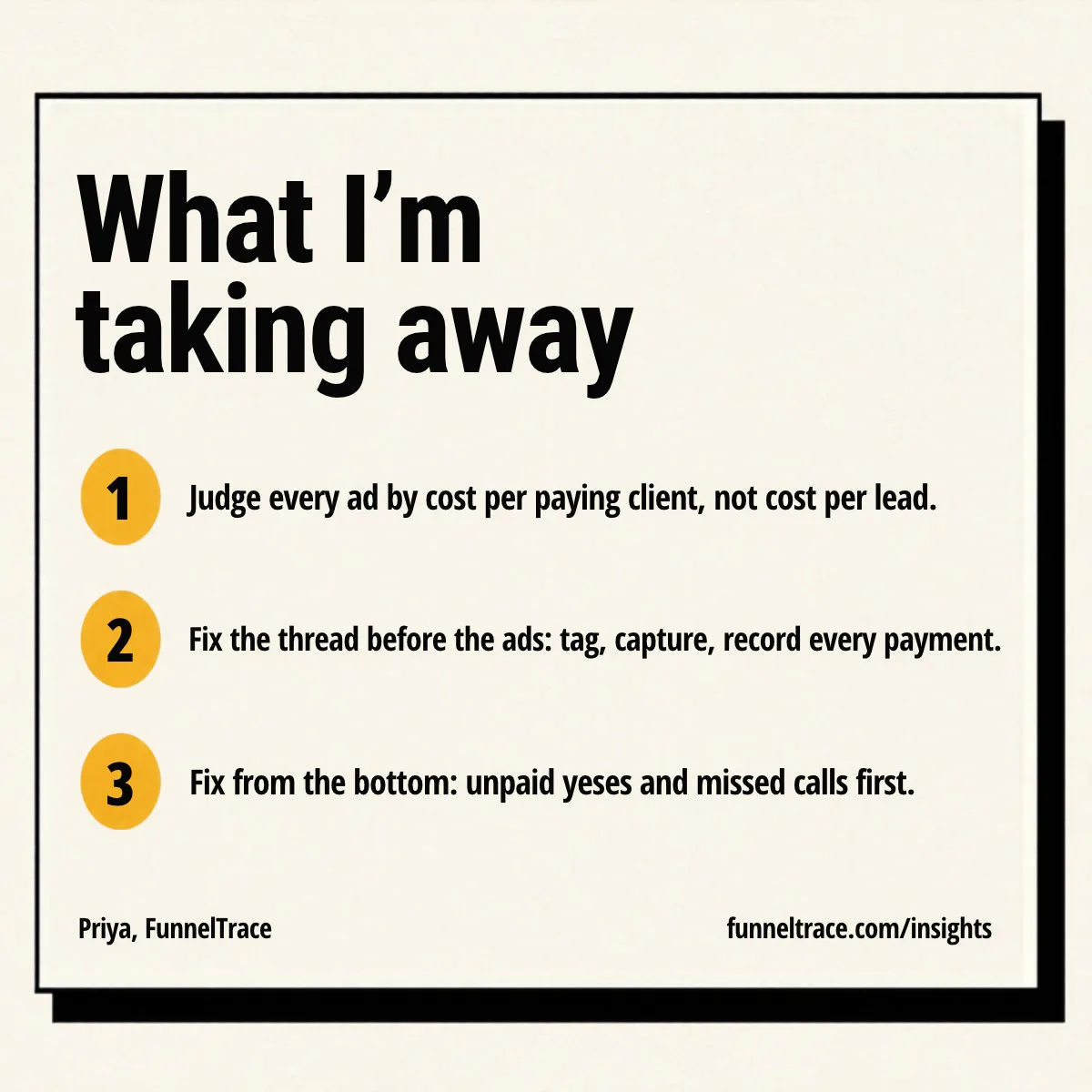
One number decides. Cost per paying client, not cost per lead. Everything else is a step on the way to it.
Fix the thread before the ads. Tag the ad, capture it on the form, and record every payment, UPI included, against the same person.
Fix from the bottom. Unpaid yeses and missed calls cost you more than a tired ad, and they're cheaper to fix.
Frequently asked questions
What is a sales funnel for coaches?
It's a planned path from a stranger seeing your ad to that person paying for your programme. For most Indian coaches it has five steps: an ad, a page that captures name and phone, a trust-building event such as a workshop, a sales conversation on a call or WhatsApp, and a payment. Each step has a number you track.
How much does a coaching funnel cost to run in India?
Ad spend is the main cost; many established coaches run around ₹1 lakh a month. On top come software and payment fees: Razorpay's standard rate is 2% plus 18% GST, about ₹1,062 on a ₹45,000 payment (checked 26 Nov 2026). The hidden cost is your time on calls, roughly 18 hours for 24 calls of 45 minutes.
Should my workshop be free or ₹99?
A free workshop brings more registrations at a lower cost each. A ₹99 workshop usually brings fewer people who have shown they'll pay something, and the fees offset part of the ad spend. Neither wins by default. Compare them on cost per paying client over two or three cycles.
Do I need a website as well as a funnel?
Not to start. A funnel needs a capture page, a thank-you page and a way to take payment. A website helps later, when people search your name after seeing an ad and want to check you're real. If you're choosing where to spend the first month, build the funnel pages and tracking first.
What is a good conversion rate for a coaching funnel?
There's no reliable Indian benchmark. Published figures come from agencies and software vendors, rarely with a sample size, and they contradict each other. A more useful comparison is your own previous cycle: if cost per paying client fell and call quality held, the funnel improved. Use outside ranges only to sanity-check a plan.
How long before I know if my funnel works?
Longer than one cycle. With five or six clients a month, one sale swings your cost per client sharply, so a single round can flatter or condemn a funnel unfairly. Budget for two or three workshop cycles, change one step between each, and watch earlier signals such as held calls per ad while client numbers build.